
Great Depression and New Deal Reading Passages and Test Prep
Teach the content and the test in the same lesson
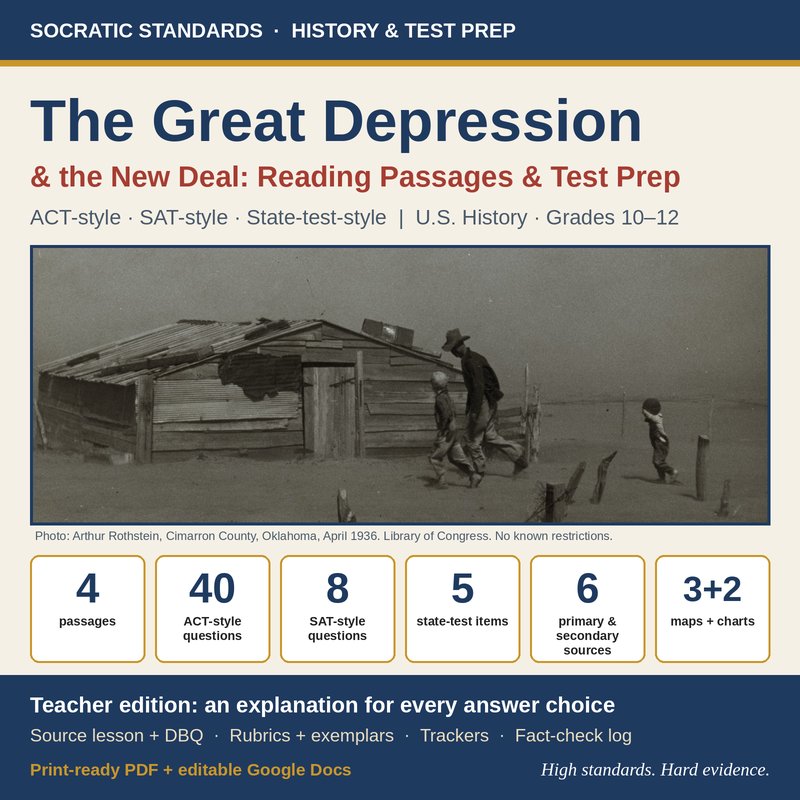
This unit covers the 1929 crash and why it became a depression, daily life and the Dust Bowl, the New Deal and its critics, and labor, recovery, and how the Depression ended. While students learn it, they answer questions built like the ones on the ACT, the SAT, and state tests. You don't have to give up a week of history for a test-prep unit, and you don't have to skip test prep to stay on pace.
What's in the unit
- Student Packet (43 pages): 4 ACT-style passages (674 to 747 words each) with numbered lines.
- 60 questions: 40 ACT-style (10 per passage, A–D / F–J), 8 SAT-style short texts, 7 tiered source-analysis questions, and 5 state-test-style items. Two of those items have a Part A and a Part B, so there are 62 scored responses.
- A source lesson with 4 primary sources (FDR's First Inaugural Address (quoted from the Avalon Project transcript), the Supreme Court's Schechter opinion, Dorothea Lange's "Migrant Mother," and a WPA poster) and 2 short secondary accounts, with HIPP and OPCVL organizers.
- Writing: 4 constructed responses and a DBQ-style essay on the question "To what extent did the New Deal end the Great Depression?".
- Teacher Edition (69 pages): an answer key that explains why the right answer is right and why every wrong answer is wrong, a five-day plan, differentiation notes, rubrics with exemplars, and a fact-check log.
- Formats: print-ready PDFs plus editable Google Docs.
Standards
Every item is tagged by skill, ACT category, SAT domain, standard, and difficulty. Common Core codes tagged on the items: RH.11-12.1, RH.11-12.2, RH.11-12.3, RH.11-12.4, RH.11-12.5, RH.11-12.6, RH.11-12.7, RH.11-12.8, RH.11-12.9, L.11-12.1, WHST.11-12.1, WHST.11-12.9. Also referenced: C3 Framework D2.His.1.9-12, D2.His.4.9-12, D2.His.14.9-12, D2.His.16.9-12, D2.Eco.12.9-12.
The Teacher Edition also lists related state codes for Texas, Florida, New York, California, and Virginia, checked on October 27, 2026.
Test-prep strategies built in
- A pacing guide based on the real section timing, and a page of ten strategies that work on any reading test.
- A strategy note on each of the 48 ACT-style and SAT-style questions in the Teacher Edition.
- Students score their work in class the same day and log why they missed each question on an error analysis tracker.
- Use it as one test-prep week or one passage a week for 4 to 6 weeks. Spacing practice out is the other high-utility method in the same 2013 research review.
Ways to use it
- A test-prep week, a weekly warm-up, intervention, or a sub plan.
- One passage a week alongside your regular unit.
- Classical education programs and classical homeschool co-ops: primary sources to question, evidence to weigh, and constructed responses and a DBQ that ask students to argue a position in writing. That's logic-and-rhetoric work on real history.
- Socratic discussion or seminar: the Teacher Edition's explanation of why each wrong answer is wrong gives you ready-made questions ("What would you have to believe for C to be right?"). There's no separate seminar guide in the unit.
One purchase covers one teacher's own classroom. In a co-op where several parents or teachers lead classes, each needs a license (TpT offers additional licenses at a discount).
Both sides, fairly
The passages lay out what the New Deal did and the criticism it drew from both the right (the Liberty League, Hoover, the Supreme Court) and the left (Long, Townsend, Coughlin). The essay rubric scores evidence and reasoning, not which side a student takes.
Good to know
- Everything is original. No real ACT, SAT, or state test items are used.
- It's built to grow content knowledge and familiarity with test formats at the same time.
- Reading level: Flesch-Kincaid grade 11.0 to 12.1. No Lexile measure was taken.
- Passage 2 covers hardship that fell unevenly, including discrimination against Black workers, the forced and pressured departures of Mexican Americans, and the exclusion of farm and domestic workers from early Social Security. You may want to read it before class.
Get it on TpT — $7 A purchase covers one teacher's own classroom. Buying for a group? Contact us.
What reading skills does this Great Depression unit practice?
Students do close reading of complex informational and primary-source text on the Great Depression and New Deal. They use evidence, make inferences, consider the author's purpose, and determine vocabulary in context, then answer exam-style questions and work with a DBQ in the same lesson.
Frequently asked questions
What is included in the Great Depression and New Deal unit?
Reading passages, exam-style questions, a teacher key, and a DBQ for grades 10-12. The buy button on this page goes to the live Teachers Pay Teachers listing. A purchase covers one teacher's own classroom.
How does this Great Depression unit put the research into practice?
The unit teaches required content and high-level reading skills in the same lesson, with exam-style questions, a teacher key, and a DBQ. I built it to align with research on close reading and document-based history work.
Related
- World War II Reading Passages and Test Prep
- How to read an ACT reading passage under time pressure
- What a primary source evaluation question is really asking
- Free class and student trackers
- High-level reading in history class
ACT® is a registered trademark of ACT, Inc. SAT® is a registered trademark of the College Board. Neither is affiliated with or endorses this product, and neither is any state testing agency.